

The Latest Data on SNAP’s Impact on Poverty & Food Insecurity

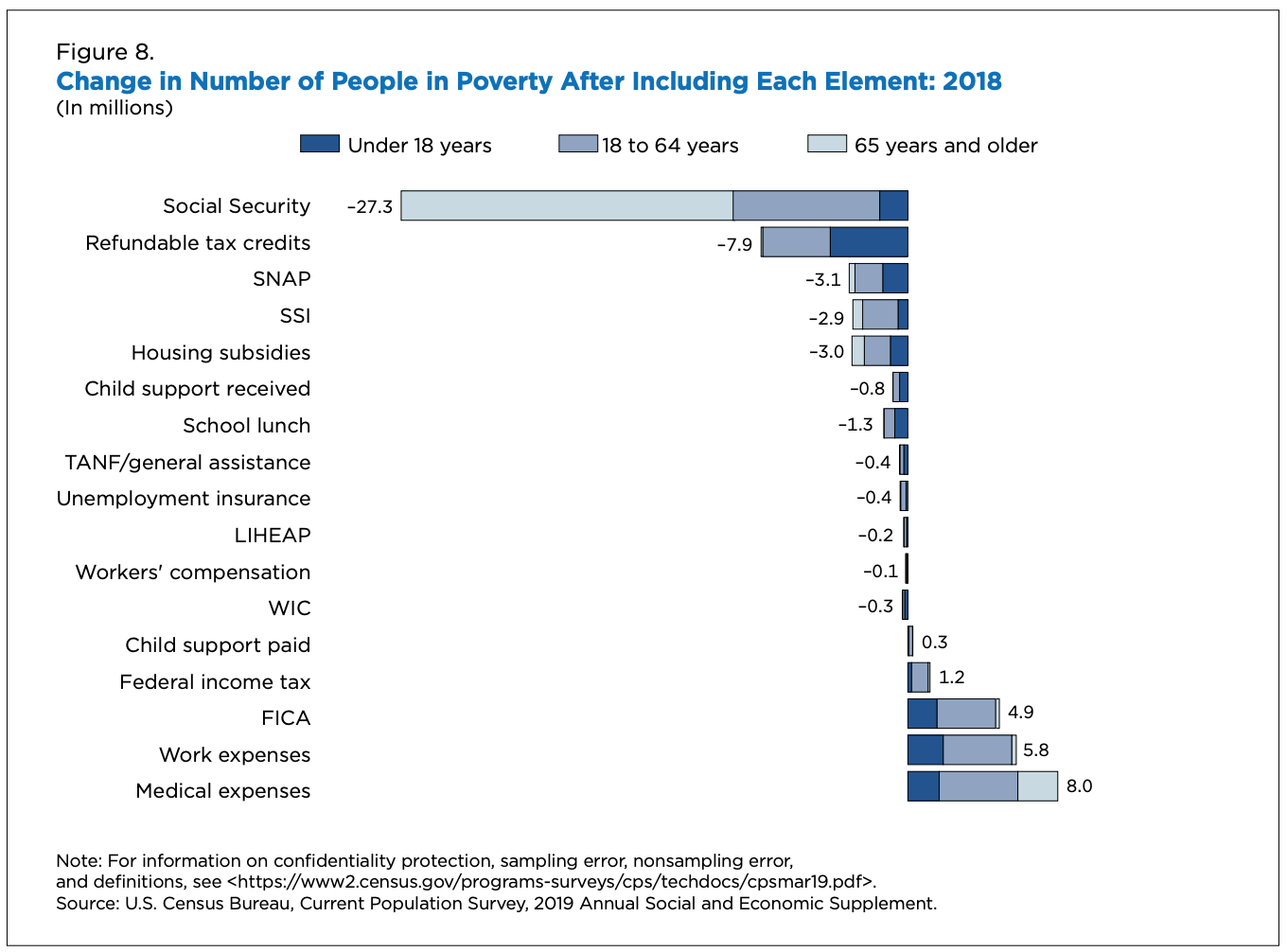
This past week, the Census Bureau released their latest reports on Income, Poverty and Health Insurance in the United States. They found that SNAP lifted 3.1 million people out of poverty in 2018 alone. Social safety programs as a whole lifted 47 million people out of poverty the very same year.
A week prior, the USDA’s Economic Research Service (ERS) released their report on food insecurity in the United States. They asked Americans 10-18 questions such as “In the last 12 months, were you ever hungry, but didn’t eat, because there wasn’t enough money for food?” and “‘The food that we bought just didn’t last and we didn’t have money to get more.’ Was that often, sometimes, or never true for you in the last 12 months?” Their findings highlighted that 11.1% of households in America are still food insecure. In other words, 1 in 8 Americans don’t have access to adequate food.
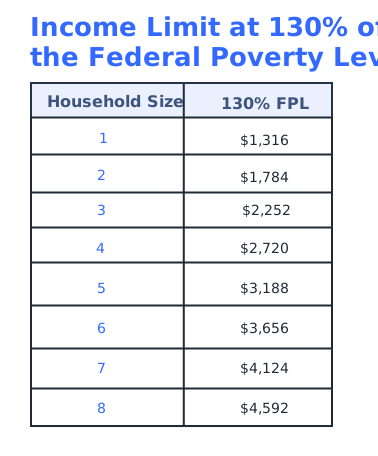
Diving deeper into the numbers from the ERS report, we get a picture of communities that are highly vulnerable to food insecurity. Of Americans making below 130% of the federal poverty line (FPL), which is the qualifying income limit for SNAP without the flexibility of BBCE, 33.1% are food insecure. That’s three times the national average. In this already hard-hit community, we see even more startling numbers:
- 42% of households headed by single women making below 130% FPL are food insecure
- 39% of black households making below 130% FPL are food insecure
- 37% of rural households making below 130% FPL are food insecure
As consistently evidenced by the Census Bureau’s research, SNAP is a vital anti-poverty program. But what kind of effect does it have on food security? Surprisingly, this has been a hard question to answer due to a phenomenon called “self-selection.” Based on the report conducted by ERS, households at 130% FPL who participated in SNAP were more food insecure than households at 130% FPL who didn’t participate in SNAP.
But this is far from the full picture. I spoke with Alisha Coleman-Jensen, lead economic researcher with ERS, about the selection effect. “The issue is that those households that get SNAP, in economic research-speak, are selecting into the program...they’re choosing to get SNAP because they need it. Because there are barriers to participation with regards to the application process and potential stigma, people are only going to enroll in the program if they really need it. Those households that are more food needy are getting in the program and so they’re showing to have higher food insecurity rates. You can’t use [this data] to say that food insecurity is harmed or worsened by SNAP participation. You need to do more complex analysis that can try to account for those selection effects in the program.”
Researchers, including Coleman-Jensen, have set out to tackle this complex analysis. These studies have ranged from working to control for the selection effect to assessing the impact of the buying power of benefits based on food prices to understanding the food needs of folks who leave the program. “All of these studies have pointed toward SNAP being effective at reducing food insecurity,” explains Coleman-Jensen. “And the studies are coalescing around the idea that the larger buying power of SNAP does more to alleviate food insecurity.”
Compellingly, SNAP has been proven to have an ameliorative impact on poverty and food insecurity. What does this data mean for platforms like mRelief? We need to keep working to boost accessibility to SNAP and especially focus on reaching single mothers, black households and rural households, who are the most vulnerable when it comes to food security.
