Key Takeaways
- People who live with and care for someone with a disability can apply for separate SNAP benefits from them. This is true even if they buy and cook meals for the person with a disability (except for spouses or children under age 22).
- A person with a disability can apply for SNAP separate from a caretaker they live with who makes their meals as long as they don't often eat the same food.
Introduction
Rules for food stamps eligibility are complicated. We get it. No one expects an applicant to read their state’s 42 chapters long food stamp policy manual. That’s why mRelief works every day to transform the SNAP enrollment process. We designed our eligibility screener to make it easy to find out whether you qualify for food assistance. Yet some people who use our screener are still hesitant to apply due to damaging misinformation about eligibility.
We recently had the below exchange with a 65-year-old in California, who we will refer to as Steve. mRelief helped Steve find out he was likely eligible for CalFresh food stamps, but he didn’t submit an application because he thought he would not be approved:
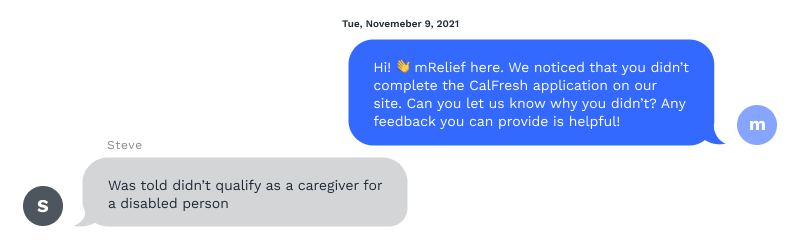
Let’s clear up this SNAP myth for Steve!
Generally, a SNAP household is anyone who lives together and regularly buys and cooks meals together. However, people who are disabled who live with a caregiver who buys and cooks their food can often still qualify for separate SNAP benefits. The deciding factor is whether most of the food purchased (more than 50%) and prepared is for the benefit of the person with a disability, or for the consumption of all household members.
That means that even if the disabled person Steve cares for lives in the same home as him, as long as they don’t eat the majority of their meals together, they can apply as separate households. (The one exception to this rule is if the person Steve provides care for is his child under the age of 22 or is his spouse.)
Steve told us he is a single person household. So we will assume that the person he is caring for would not be a required household member and would not need to be included on Steve’s food stamp application. In that case Steve is likely eligible! 🥳
Where did this myth come from?
The federal government has two different policies regarding household status for people with disabilities who cannot buy and cook their own food.
We describe the first policy in the sample case with Steve. In this policy, the household definition for a person with a disability is redefined to include sharing meals, not buying or cooking them. As long as the meals are bought and prepared for the benefit of the disabled person, the caregiver and the person with a disability can apply for SNAP as separate households. If the caregiver and the disabled person regularly share meals, then the disabled person must include the caregiver in their household.
A separate policy allows individuals over the age of 60 who have a recognized disability to apply as a separate household from those they live with and eat with regularly. People may do this as long as the others in their household earn less than 165% of the federal poverty line (FPL).
Options for People with Disabilities Applying for Food Stamps
If food is bought and cooked for shared consumption by all household members, including the person with a disability
Then the person with disabilities may qualify for separate food stamps benefits only if they are elderly (age 60+) and the remaining household members have gross income below 165% of the federal poverty level.
If food is purchased and prepared by a caregiver separately for consumption by the person with a disability
Then the person with disabilities qualifies as a separate SNAP household. It does not matter if the caregiver lives with the disabled person.
Except when the caregiver is a spouse, the parent of a child with a disability under age 22 , OR a child under age 22 who cares for a parent with a disability.
Then the spouse, the child under 22 and/or the parent of a child under 22 must be in the same SNAP household if they live in the same home. It does not matter if food is purchased and prepared separately or in common in this situation.
In our sample case, this means that regardless of the income of the person Steve provides care for, as long as they do not eat the majority of their meals together, Steve should be able to qualify as a separate, single-person household.
Don’t let myths keep you from getting support.
We can help you sign up for food stamps today.
Resources
- USDA (2021). Special rules for household members who are elderly or disabled
- Health Affairs (2021). Food insecurity in the disability community: Disparities In SNAP access.